

DJ reliability is defined as the consistent, stable delivery of professional DJ services regardless of venue conditions, equipment variables, or crowd size. For nightclub owners and event planners, why DJ reliability matters for clubs comes down to one core truth: a single failed set can cost you a full room, a repeat booking, and your venue's reputation. Industry guidance in 2026 confirms that staying booked depends on repeated reliable performance, not one exceptional night. Tools like Pioneer CDJs, offline libraries from ZIPDJ, and standards from the UK National Association of DJs (NADJ) all point to the same conclusion. Reliability is the professional baseline every club must demand.
Why DJ reliability matters for clubs: the operational stakes
DJ reliability in a club context is not just about showing up on time. It covers every variable that could interrupt a live set, from streaming failures to missing cables to power outages. When any one of those variables breaks down, the crowd feels it immediately.
The most common operational risks fall into three categories:
- Streaming dependency failures. Wi-Fi outages, network latency, and unpredictable catalog changes can all kill a set mid-track. Offline playback should be standard in 2026, with streaming treated as a fallback, not the primary source. A DJ who relies entirely on a cloud library is one router reboot away from dead air.
- Power and network disruptions. Even a brief outage can force a full power cycle of DJ gear, lighting rigs, and networking equipment. 30-minute outages at major venues can cost hundreds of thousands of dollars in lost revenue and reputational damage. That number reflects how quickly a single infrastructure failure compounds.
- Day-of preparation lapses. Missing adapters, wrong cables, and poor advance communication with venue staff are the most preventable failures. NADJ 2026 guidance stresses that bringing labeled backup kits before doors open stops small problems from becoming show-stopping ones.
Audio dropouts and dead air during a set break crowd trust instantly. Fixing them often requires disruptive power cycles that pull the audience out of the experience entirely. The reputational damage from one bad night travels faster than any positive review.
Pro Tip: Ask every DJ you book to walk you through their backup plan before the event. If they don't have one, that tells you everything you need to know about their reliability.
How do reliable djs deliver consistent performances?
Reliable DJs treat every performance as an engineering problem, not a creative gamble. The behaviors that separate dependable professionals from unpredictable ones are specific and repeatable.
-
Pre-show gear and library testing. A reliable DJ tests every cable, adapter, and audio output before the venue opens. They verify that their local music library loads correctly on the hardware they will use that night. Peak-load failures rarely appear in quick pre-show checks. They surface under full-room stress, which means stress-testing the setup before the crowd arrives is non-negotiable.
-
Offline-first library management. Services like ZIPDJ allow DJs to maintain curated, downloaded libraries that perform without any network connection. Treating reliability as an engineering problem means never outsourcing your set to Wi-Fi or cloud services. An offline primary library with a tested backup drive is the 2026 industry standard.
-
Set adaptability across room sizes and soundsystems. A DJ who only performs well in one specific booth configuration is a liability. Promoters seek DJs who deliver consistently across varying booth conditions, crowd moods, and venue sizes. Why DJ versatility matters for clubs is directly tied to this point. Versatility without reliability is just potential. Reliability without versatility is a ceiling. You need both.
-
Clear communication with venue staff and promoters. NADJ defines reliability as encompassing safety awareness, client communication, and venue-specific preparation. A DJ who confirms load-in times, asks about the soundsystem in advance, and checks in with your production team is demonstrating reliability before they ever touch the decks.
Pro Tip: Request a pre-event technical rider from every DJ. It reveals their experience level, what backup gear they carry, and whether they have thought through the venue's specific setup.
How can venues support DJ reliability through infrastructure?
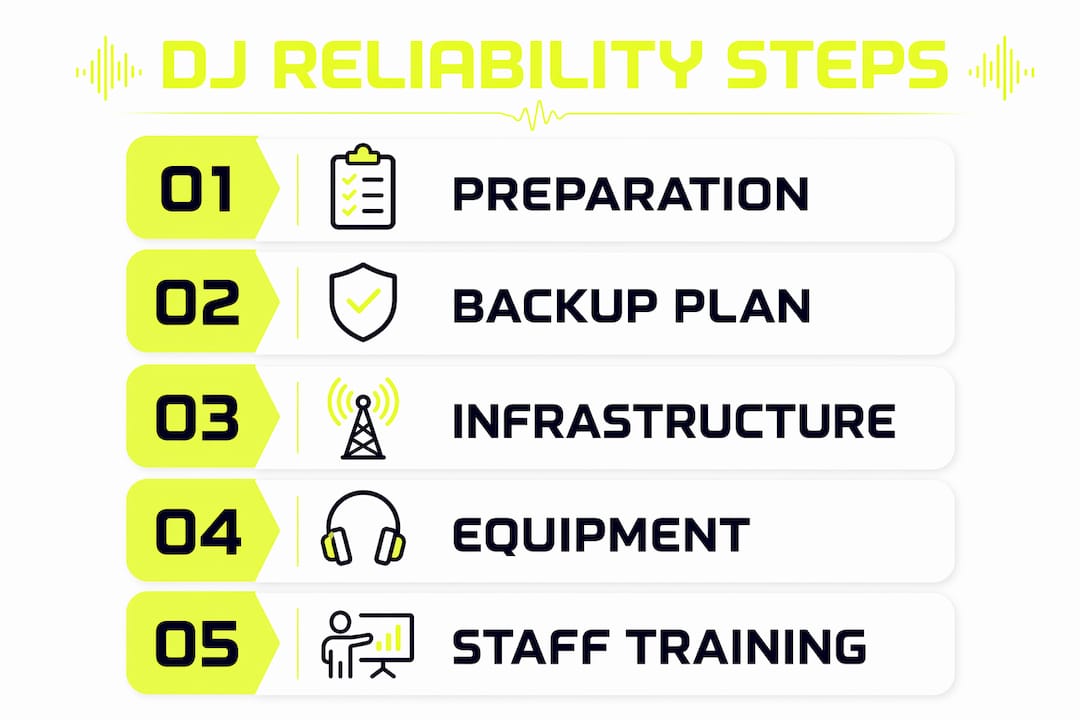
Venue operators carry more responsibility for DJ reliability than most realize. A DJ can arrive fully prepared and still fail if the venue's infrastructure is not built to support a stable performance.
Power redundancy is non-negotiable
Uninterruptible power supplies (UPS) protect networking gear, lighting controllers, and DJ equipment from sudden outages. Operational redundancy including UPS backup for networking is the 2026 standard for venues that host regular DJ events. Without it, a single power fluctuation can cascade into a full system failure.

Wired networks over wi-fi for critical systems
Wi-Fi is convenient but unreliable under peak load. A packed room of 300 people all on their phones creates network congestion that directly affects streaming-dependent DJ setups. Running a dedicated wired ethernet connection to the DJ booth removes the most fragile link in the chain.
Key venue-side reliability measures include:
- Dedicated wired ethernet drops at every DJ booth
- UPS units protecting networking switches, routers, and DJ gear
- Pre-event technical checks run jointly by venue staff and the DJ
- Clearly documented emergency protocols for power or audio failures
- On-site backup equipment including spare cables, DI boxes, and audio interfaces
Staff training and collaborative risk management
Your production staff needs to know what a DJ setup requires and what to do when something goes wrong. A venue that trains its crew on basic audio troubleshooting and emergency protocols reduces the time between a failure and a fix. That gap is where crowd trust evaporates.
| Venue Action | Reliability Benefit |
|---|---|
| Install UPS on networking gear | Prevents cascading failures from power fluctuations |
| Run wired ethernet to DJ booth | Eliminates Wi-Fi congestion as a failure point |
| Conduct joint pre-event tech checks | Catches setup issues before doors open |
| Stock backup cables and DI boxes | Reduces downtime from simple equipment failures |
| Train staff on audio emergency protocols | Speeds up response time when failures occur |
CDJ setups vs. streaming and controller rigs: which is more reliable?
DJ experience level and setup choice directly affect how much risk you carry as a venue. Not all DJ rigs perform equally under club conditions.
Pioneer CDJ players, specifically the CDJ-2000NXS2 and CDJ-3000, are the industry standard for club reliability. They read from USB drives, operate independently of laptops, and have a track record of stable performance under heavy use. Why DJ backup equipment matters becomes obvious when you compare CDJ setups to controller rigs. Controllers depend on a laptop running DJ software like Serato or Rekordbox. If that laptop crashes, the set ends.
Streaming-based setups introduce the weakest-link problem. The entire set depends on the most fragile component in the venue's network. One congested router or dropped connection pulls the whole performance down with it.
| Setup Type | Reliability Level | Key Risk | Best Mitigation |
|---|---|---|---|
| Pioneer CDJ + USB drive | High | USB drive failure | Carry two formatted backup drives |
| Controller + laptop | Medium | Laptop crash or software freeze | Backup laptop with pre-loaded library |
| Streaming only | Low | Network outage or latency | Add offline backup library immediately |
| Hybrid CDJ + offline library | Very High | Minimal | Stress-test before every show |
The hybrid approach, using Pioneer CDJs loaded with an offline ZIPDJ library and a tested backup USB, represents the most dependable setup available in 2026. Why DJ genre matching matters also plays a role here. A DJ with the right offline library for your crowd's genre preferences removes the temptation to rely on streaming for obscure tracks.
Key takeaways
DJ reliability is the single most important factor in club event success because it determines whether your venue delivers a consistent, trust-building experience every night.
| Point | Details |
|---|---|
| Reliability over brilliance | Promoters book DJs who perform consistently, not those who peak occasionally. |
| Offline libraries are the standard | ZIPDJ and similar offline tools remove network dependency from live sets. |
| Venues share the responsibility | UPS units, wired ethernet, and staff training directly support DJ performance stability. |
| CDJ setups outperform controllers | Pioneer CDJ rigs with USB drives carry far less failure risk than laptop-dependent controllers. |
| Preparation prevents most failures | Labeled backup kits and pre-event checks stop small problems from ending shows. |
What 15 years of club events taught me about DJ reliability
The industry talks about DJ talent constantly. Reliability barely gets mentioned until something goes wrong. That imbalance is the real problem.
I have watched technically gifted DJs lose residencies because they showed up unprepared twice. I have also watched DJs with average technical skills hold down the same Friday night slot for three years straight because they never gave a promoter a reason to worry. The transition from being booked for potential to being booked for reliability is the professional turning point that separates working DJs from struggling ones.
The uncomfortable truth is that most reliability failures are not dramatic. They are a missing XLR cable. A laptop that was not restarted before the show. A streaming library that dropped three tracks in a row because the venue's router was overloaded. None of those failures require bad luck. They require only a lack of preparation.
For venue operators, the mindset shift is this: stop treating reliability as the DJ's problem alone. Your infrastructure either supports a stable performance or it does not. A DJ who arrives with two backup USB drives and a labeled cable kit cannot save a set if your venue's networking gear goes down and you have no UPS in place. Reliability is a shared system, and every component of that system needs to be tested before the room fills up.
— Trama
How Deimossound keeps your club events running without interruption
Reliability is built before the first track plays. Deimossound delivers professional DJ event services designed specifically for venues and event planners who cannot afford a failed night. Every booking includes pre-event technical coordination, tested audio-visual equipment, and a backup readiness standard that matches 2026 industry best practices.

Whether you are running a weekly club night or a one-time large-scale event, Deimossound brings the preparation, gear redundancy, and communication protocols that turn reliability from a promise into a result. Rates start at $75 per hour. Explore event gear and services or reach out directly to discuss your venue's specific needs.
FAQ
What does DJ reliability mean for nightclubs?
DJ reliability means consistent, stable performance across every event regardless of venue conditions, crowd size, or equipment variables. It includes preparation, backup gear, offline music libraries, and clear communication with venue staff.
Why do promoters prioritize reliability over DJ talent?
Promoters book DJs who deliver consistently across varying conditions because reliability reduces operational risk and protects the venue's reputation. One exceptional set does not compensate for two unreliable ones.
What is the biggest technical risk for djs in clubs?
Streaming-dependent setups are the highest-risk configuration because the entire performance depends on the venue's network stability. Offline primary libraries with tested backup drives are the 2026 standard for minimizing this risk.
How should venues prepare their infrastructure for DJ events?
Venues should install UPS units on networking gear, run dedicated wired ethernet to the DJ booth, conduct joint pre-event technical checks with the DJ, and train staff on basic audio emergency protocols.
Does DJ experience level affect reliability?
Yes. More experienced DJs carry tested backup systems, communicate technical requirements in advance, and adapt to unexpected booth conditions without disrupting the set. Why DJ experience level matters is directly tied to how a DJ handles failure scenarios, not just how well they perform under ideal conditions.