
Club lighting programming is defined as the use of the DMX512 protocol to control multiple lighting fixtures simultaneously, building synchronized, music-responsive scenes that shape the atmosphere of any entertainment venue. Known in the industry as DMX lighting control or fixture programming, this discipline sits at the intersection of technology and artistry. Whether you are an event professional managing a full nightclub rig or a hobbyist setting up your first DJ lighting setup, understanding how to program club lights separates a forgettable night from one people talk about for weeks. A single DMX universe controls 512 channels, giving operators precise management over color, movement, intensity, and timing across an entire room.
What is club lighting programming and why does it matter?
Club lighting programming is the structured process of assigning DMX channels to fixtures, building scenes, and triggering those scenes in response to music and event energy. The goal is not simply to make lights flash. The goal is to create a visual language that mirrors the rhythm and emotional arc of the night.
Effective club lighting enhances venue identity, supports social media visibility, and reduces long-term maintenance costs. That last point surprises most newcomers. A well-programmed system runs fixtures at appropriate intensities and duty cycles, which extends lamp and LED life considerably.
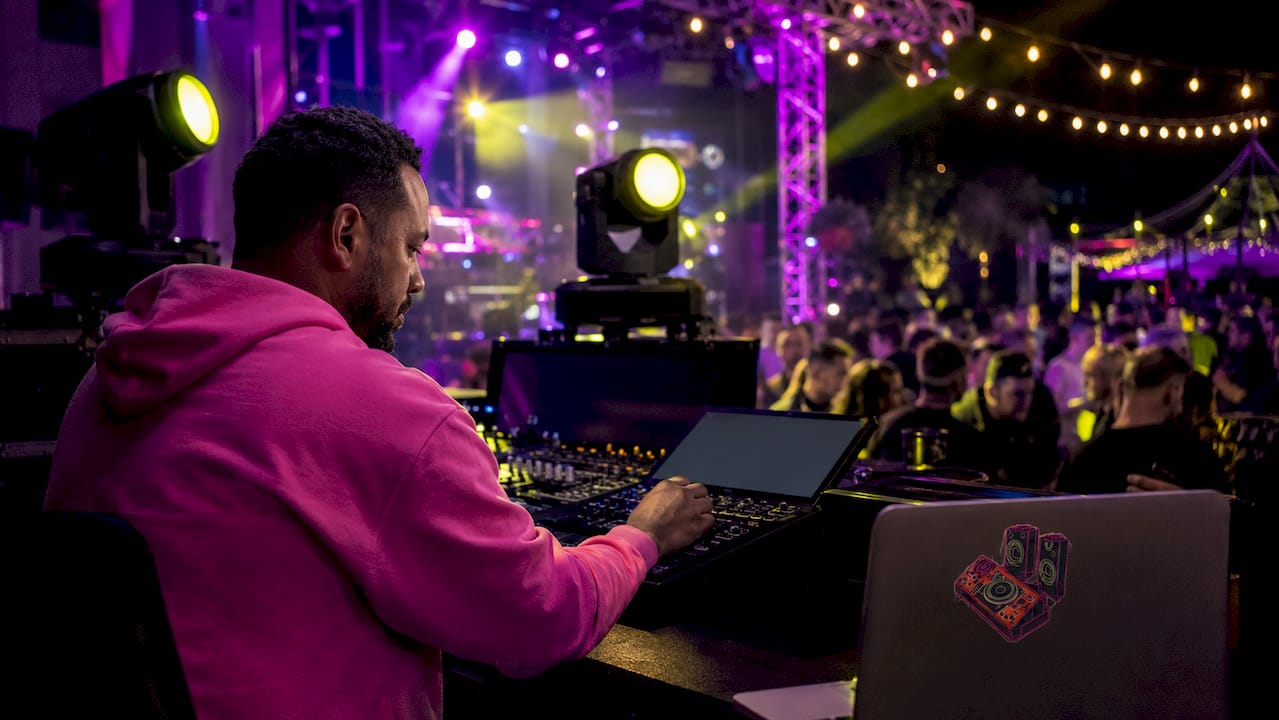
The distinction between club lighting programming and basic lighting operation matters. Plugging in a fixture and hitting a sound-activated mode is operation. Building a library of scenes, mapping them to musical energy levels, and executing them with intention is programming. Professionals and serious hobbyists both benefit from learning the structured approach.
How does DMX512 control work in club lighting programming?
DMX512 is a serial communication protocol that sends data from a controller to fixtures through a daisy-chained cable network. Each fixture receives a unique start address, and the controller sends values from 0 to 255 for every channel in the universe. A moving head fixture might use 16 or more channels, covering pan, tilt, color wheel, gobo, dimmer, and strobe functions independently.
DMX addressing by function, not physical installation order, is the single most important principle in efficient programming. When all moving heads share a consecutive address block, a programmer can select that group and build movement scenes without touching wash or strobe fixtures. This saves hours during setup and makes live adjustments far cleaner.
Here is how a typical address map looks for a medium club rig:
- Moving heads (beam/spot): Addresses 1–64, grouped for synchronized movement and gobo selection
- Wash fixtures (LED par or bar): Addresses 65–128, grouped for color mixing and ambient fill
- Strobe units: Addresses 129–160, isolated for peak-moment triggering
- DJ booth fixtures: Addresses 161–192, kept separate for independent control during transitions
- Accent and effect lights: Addresses 193–256, reserved for specialty effects like UV or laser
Pro Tip: Always leave address gaps between fixture groups. If a fixture mode update adds channels, you will not need to re-address your entire rig.
A DMX chain runs from the controller output through each fixture in sequence. Signal integrity depends on proper cable quality and chain length management. A 120-ohm resistor terminator at the end of the chain prevents signal reflection, which causes erratic fixture behavior sometimes called "phantom" movement.
What are the functional layers in a professional club lighting setup?
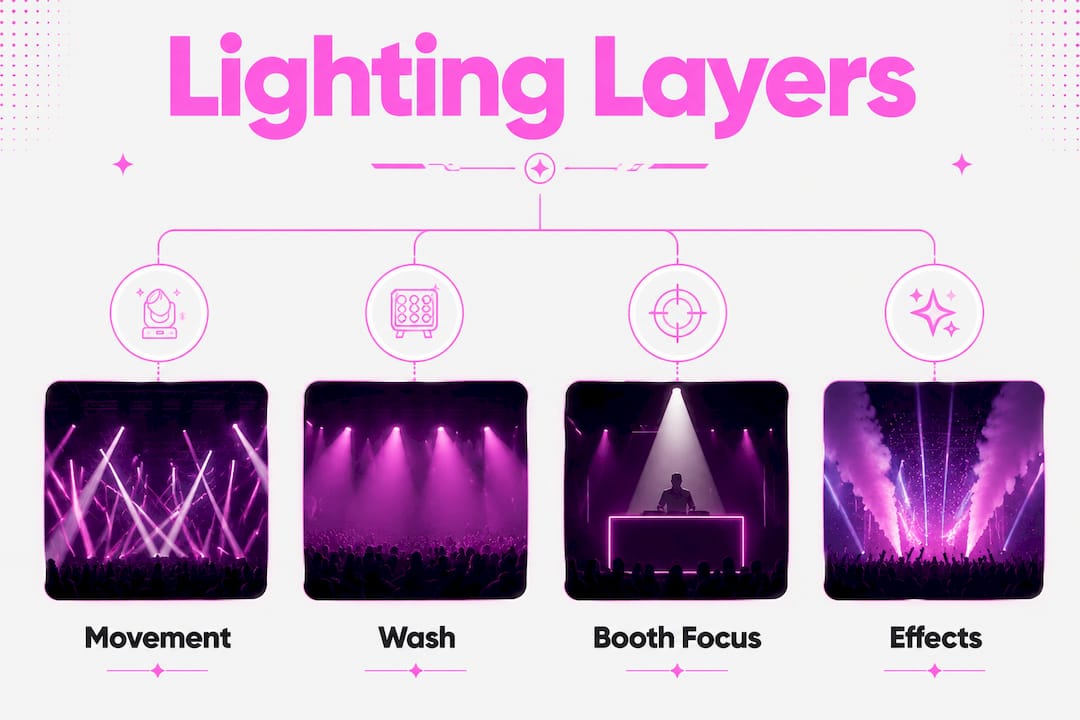
Standard professional setups incorporate at least four layers to enable sophisticated and varied visual scenes. Each layer serves a distinct role, and the interaction between layers produces the visual complexity that defines a great club atmosphere.
| Layer | Fixture Type | Primary Role |
|---|---|---|
| Movement | Moving heads (beam or spot) | Beam sweeps, aerial effects, crowd scanning |
| Wash | LED pars, bars, or battens | Color fills, mood transitions, ambient tone |
| Booth focus | Front-facing spots or wash | Illuminating the DJ and performance area |
| Accent and effects | Strobes, UV, lasers, hazers | Peak moments, texture, spatial depth |
The movement layer carries the most visual energy. Moving heads respond to musical peaks with fast pan and tilt sequences, gobo rotations, and beam narrowing. The wash layer acts as the emotional backbone of the scene, setting the color temperature and saturation that define whether a moment feels tense, euphoric, or cool.
Zoning lighting systems to match the dance floor, DJ booth, and entrance areas enhances venue ergonomics and atmosphere. A common mistake is treating the entire room as one zone. When the entrance area runs the same scene as the dance floor, the venue loses depth and spatial storytelling.
The booth focus layer deserves more attention than it typically receives. A well-lit DJ creates a focal point that anchors the crowd's energy. Flat or absent booth lighting makes the performance feel disconnected from the room, even when the music is excellent.
- Low-energy scenes: Wash layer dominant, soft colors, slow movement, strobes off
- Mid-energy scenes: Movement layer active, color shifts on wash, occasional strobe bursts
- Peak scenes: All layers firing, fast movement, full strobe, saturated wash colors
How to program club lighting scenes that sync with music
Sound-activated lighting modes are quicker to deploy but less controlled and more repetitive compared to programmed music sync. Sound-activated modes react to audio amplitude, which means every kick drum triggers the same response regardless of where the song sits in its structure. The result feels mechanical after about 20 minutes.
BPM-aware software or time-coded cues mapped to song structure produce far more intentional experiences. BPM logic lets the controller calculate beat timing and trigger scene changes on the one, the four, or the eight, matching the natural phrasing of electronic music. Time-coding goes further, locking specific cues to exact moments in a pre-planned set.
For live DJ events where the set is not pre-planned, the most effective approach combines pre-built scene libraries with real-time operator control. You can learn more about syncing light and sound for a deeper look at how this works in practice.
Here is a practical scene-building sequence for a four-hour club event:
- Opening (hour one): Low-energy wash scenes with slow color cycling. Movement heads park in neutral positions. No strobes. This sets the room without overwhelming early arrivals.
- Build (hour two): Introduce mid-energy scenes. Movement heads begin slow sweeps. Wash colors shift toward higher saturation. Brief strobe bursts on musical drops.
- Peak (hours three and four): Full scene library active. Fast movement, saturated wash, strobe on every major drop. Operator rides the fader to match DJ energy in real time.
- Cooldown (final 20 minutes): Return to low-energy wash. Movement heads slow. This signals the end of the night without a jarring cutoff.
Pro Tip: Program a "blackout safe" scene that kills all movement and drops wash to 10% intensity. Trigger it during technical issues or unexpected pauses to avoid a frozen rig drawing attention.
Multiple fixture layers responding differently to musical sections create contrast and audience engagement. The key is that not every layer should fire at maximum intensity simultaneously. Restraint during build sections makes the peak scenes land harder.
What are common challenges and best practices in club lighting programming?
Improper DMX addressing causes more show failures than any other single issue. When two fixtures share the same start address, they respond identically to every command, which eliminates independent control and can produce erratic behavior if their channel counts differ.
Grouping fixtures by function rather than physical position accelerates scene building and reduces programming errors. Document every address assignment in a channel map spreadsheet before the first fixture goes up. This document becomes the foundation for troubleshooting, expansion, and handing off the rig to another operator.
Lighting must support venue identity and musical energy flow. More fixtures do not automatically produce a better show. A disciplined, layered approach with intentional scene design consistently outperforms a larger rig operated without structure.
Best practices that separate professional rigs from amateur setups:
- Use DMX terminators on every chain. A 120-ohm terminator at the final fixture prevents signal reflection and phantom behavior.
- Document fixture modes. Each fixture model offers multiple channel modes. Record which mode each unit runs so replacements are configured correctly.
- Plan for expansion. Leave address space between groups so adding fixtures does not require a full re-address.
- Test each fixture independently before building scenes. Confirm pan, tilt, color, and dimmer all respond correctly at the address level.
- Avoid visual exhaustion. Strobes running continuously for more than 90 seconds lose their impact and fatigue the audience. Reserve them for genuine peaks.
Programming scenes by spatial and rhythmic structure rather than random chasing creates a more immersive experience. Random chasing is the lighting equivalent of playing every instrument at full volume simultaneously. Structure gives the audience something to feel, not just see.
Key takeaways
Club lighting programming requires DMX512 channel addressing, functional fixture grouping, and layered scene design to produce music-responsive atmospheres that hold an audience's attention across an entire event.
| Point | Details |
|---|---|
| DMX512 is the foundation | A single universe controls 512 channels, enabling precise multi-fixture management. |
| Address by function, not position | Group moving heads, washes, and strobes in separate address blocks for faster programming. |
| Four layers define professional rigs | Movement, wash, booth focus, and accent layers each serve a distinct visual role. |
| BPM-aware sync beats sound-activated modes | Structured scene programming matches musical phrasing and creates intentional experiences. |
| Document everything | A channel map spreadsheet prevents addressing errors and supports future expansion. |
Why structured programming changed how I think about lighting design
The shift from reactive to planned lighting is the single biggest leap in event production quality I have witnessed over the past decade. Early in my career, sound-activated modes felt like enough. The lights moved with the music, the crowd responded, and the night felt alive. Then I watched a properly programmed rig run through a four-hour set, and the difference was immediate and undeniable.
What struck me was not the fixture count or the brightness. It was the restraint. The operator held back the movement layer during the build, let the wash carry the emotional weight, and then released everything on the drop. The crowd did not just react. They felt it coming. That anticipation is only possible when the lighting tells the same story as the music.
The lesson I keep returning to is that venue identity and musical energy must drive every programming decision. A corporate event and a drum and bass night both use the same DMX protocol, but the scene libraries, the color palettes, and the trigger logic should be completely different. Programming is not a technical task you complete once. It is a creative practice you refine every time you run a show.
For hobbyists, the good news is that the principles scale down cleanly. A four-fixture rig with a basic DMX controller can still run layered scenes if you address thoughtfully and build with intention. Start with two layers, document your addresses, and add complexity as your confidence grows. The fundamentals do not change at any scale.
— Otterpop
How Deimos Sound brings professional lighting control to your event
Deimos Sound delivers fully programmed, layered lighting systems for events of every scale, from intimate private parties to large-scale club nights. Every setup uses structured DMX control to match the visual energy to the music, so the room feels alive from the first song to the last.
Deimos Sound's approach combines expert music selection with carefully designed lighting scenes, giving clients a cohesive audio-visual experience rather than two separate services running in parallel. Rates start at $75 per hour, making professional-grade event sound and lighting accessible without the overhead of building your own rig. If you want a night that your guests remember, the programming is already done.
FAQ
What is DMX512 in club lighting?
DMX512 is a serial communication protocol that sends control data from a lighting console to fixtures through a daisy-chained cable network. A single DMX universe manages 512 channels, each carrying a value from 0 to 255 for parameters like dimmer, color, and movement.
How many fixture layers does a professional club setup use?
Professional club setups use at least four layers: movement heads, wash fixtures, booth focus lights, and accent or effect units. Each layer serves a distinct role and responds differently to musical energy.
Why is sound-activated mode less effective than programmed sync?
Sound-activated modes react to audio amplitude rather than musical structure, producing repetitive responses that feel mechanical over time. BPM-aware or time-coded programming matches scene changes to the actual phrasing and energy arc of the music.
What causes erratic fixture behavior in a DMX chain?
Missing or incorrect DMX terminators are the most common cause of erratic fixture behavior. A 120-ohm terminator at the end of the chain prevents signal reflection, which triggers unintended fixture responses sometimes called phantom movement.
How should I organize DMX addresses for a club rig?
Address fixtures by function, not physical installation order. Group all moving heads in one address block, all wash fixtures in another, and strobes separately. This structure makes scene building faster and reduces programming errors significantly.