
DJ harmonic mixing is the practice of selecting and blending tracks whose musical keys are compatible, so transitions sound musical rather than jarring. Also called "mixing in key," this technique draws on music theory principles to prevent tonal clashes between songs. The Camelot Wheel is the primary tool DJs use to apply these principles without needing a formal music education. When combined with beatmatching and careful phrasing, harmonic mixing shapes the emotional arc of an entire set, keeping dancefloors locked in and energy levels exactly where you want them.
What is DJ harmonic mixing and why does it matter?
Harmonic mixing is defined as the process of matching tracks by compatible keys to avoid dissonance during transitions. Dissonance happens when two tracks playing simultaneously contain notes that clash, creating an unpleasant, off-key sound that breaks the spell of a great set. Even a technically perfect beatmatch falls apart if the keys conflict.
The technique matters because the human ear is extraordinarily sensitive to tonal relationships. A crowd may not consciously identify a key clash, but they feel it. Energy drops, attention wanders, and the dancefloor thins. Harmonic mixing prevents that by ensuring every transition feels like a natural musical continuation.

Harmonic mixing also gives DJs a framework for intentional mood control. Moving between compatible keys is not just about avoiding bad sounds. It is a tool for building tension, releasing it, and steering the emotional temperature of a room. That combination of technical precision and emotional intelligence is what separates a good DJ from a great one.
What is the Camelot Wheel and how does it work?
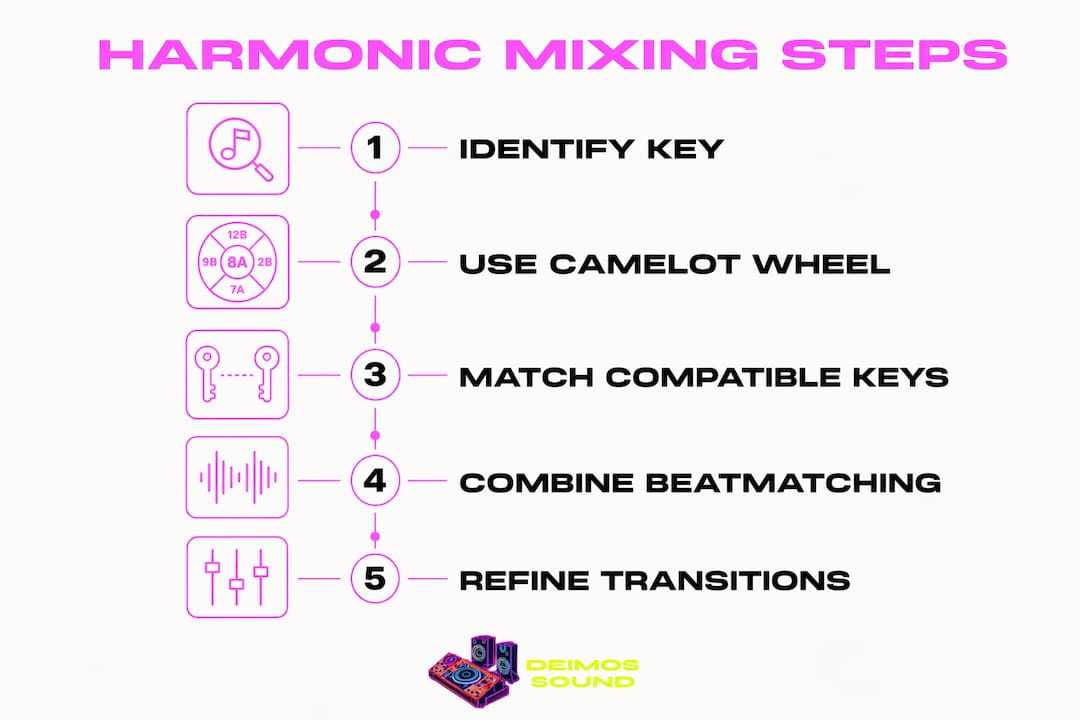
The Camelot Wheel is a clock-shaped diagram that maps all 24 musical keys into a DJ-friendly numbering system, replacing complex music theory notation with simple numbers and letters. Numbers run from 1 to 12 around the clock face. Each number has two versions: "A" for minor keys and "B" for major keys. For example, 8A is A minor and 8B is C major.
The wheel simplifies the traditional circle of fifths, which most DJs find intimidating without a music background. Instead of memorizing key signatures, you work with positions on a clock. Compatible keys sit next to each other on the wheel, making safe transitions easy to spot at a glance.
How to read compatible key positions
Three moves are universally safe on the Camelot Wheel:
- Same position: Mixing 6A into another 6A track is always harmonically safe. The keys are identical, so no clash is possible.
- Adjacent position (±1): Moving from 6A to 5A or 7A shifts the key by one step. The relationship is close enough that the transition sounds smooth and musical.
- Letter flip (same number): Moving from 6A to 6B switches between the minor and major version of a related key. This creates a noticeable mood shift while keeping harmonic compatibility intact.
These three moves cover approximately 95% of safe harmonic transitions used by professional DJs. That coverage means you can build an entire set using just these rules and rarely encounter a clash.
Pro Tip: Treat the Camelot Wheel as a map, not a mandate. If a transition looks compatible on paper but sounds off in your headphones, trust your ears. Vocal harmonics, effects tails, or unusual chord progressions can make even a "correct" move sound wrong live.
What are the core harmonic mixing techniques for DJs?
Understanding how to do harmonic mixing in practice requires more than memorizing wheel positions. The three safe moves each serve a different purpose in a set, and knowing when to use each one is the real skill.
The three foundational moves
-
Same key transitions create the smoothest, most seamless blends. Use these during peak moments when you want the energy to hold steady without interruption. Two tracks in 9A playing together sound like one continuous musical statement.
-
Adjacent key transitions (±1 step) introduce a subtle harmonic shift that the ear perceives as forward movement. Moving from 9A to 10A or 8A adds a sense of progression without breaking the mood. These work well during the build phase of a set when you want to gradually lift energy.
-
Minor to major flips (A to B or B to A) produce the most dramatic harmonic shift while staying technically compatible. Switching from 8A to 8B moves from a minor key to its relative major, which lifts or darkens energy depending on direction. Use this move when you want a clear emotional pivot without a jarring key clash.
Integrating beatmatching and phrasing
Harmonic mixing does not replace beatmatching. Both are necessary for a technically and musically clean mix. Most transitions work best within a ±6% tempo range, with phrase boundaries falling on 16 or 32 bar markers. Bringing in a new track at the wrong phrase point creates rhythmic confusion even when the keys are perfectly aligned.
Pre-cueing is the practical bridge between theory and execution. Before you bring a track in, listen to it in your headphones alongside the playing track. Software key tags are a starting point, not a guarantee. Your ears are the final authority.
Pro Tip: Before your next set, sort your library by Camelot key and practice moving through adjacent positions. Notice how each transition feels emotionally, not just technically. That emotional memory becomes your most reliable mixing tool.
How does harmonic mixing shape energy and mood in a DJ set?
Harmonic mixing is one of the most direct tools a DJ has for controlling how a crowd feels at any given moment. The direction you move on the Camelot Wheel has a measurable emotional effect.
Clockwise moves on the wheel generally raise energy and brightness, while counterclockwise moves release tension and lower intensity. This means a DJ can engineer an energy arc across an entire set simply by planning the direction of key movement. That is not an accident. It is set architecture.
Here is how these principles play out across different set contexts:
- Warm-up sets benefit from staying in stable key zones, moving minimally around the wheel. The goal is to build the room gradually without spiking energy too early. Staying within one or two adjacent positions keeps the mood consistent and inviting.
- Peak-time sets use clockwise movement and A-to-B flips to push energy upward. Each transition adds a layer of brightness or intensity, compounding the emotional effect across multiple tracks.
- Cool-down or closing sets move counterclockwise, releasing the tension built during peak time. This guides the crowd through a satisfying emotional resolution rather than an abrupt stop.
The minor-to-major flip deserves special attention for mood control. Switching from a minor key to its relative major at the same Camelot number creates an immediate lift in emotional tone. The reverse, major to minor, adds depth and introspection. These moves are the backbone of set mood control in modern electronic dance music performance.
Harmonic mixing also supports narrative arcs across longer sets. A two-hour set can tell a complete emotional story, moving from anticipation through peak euphoria to resolution, all guided by deliberate key choices. That narrative quality is what makes a great DJ set feel like an experience rather than a playlist.
What are the common challenges in harmonic mixing?
Harmonic mixing is powerful, but it comes with real-world complications that every aspiring DJ needs to understand before relying on it fully.
Key detection software is imperfect. Inaccurate key tags are the leading cause of mixing failure in otherwise well-prepared sets. Tracks with complex harmonic content, multiple key changes, or heavy use of effects often get mislabeled by automated analyzers. Dedicated key analysis tools provide more reliable results than general-purpose DJ software, but even those require verification.
Several specific challenges come up regularly in practice:
- Mislabeled tracks can send you into a transition that looks safe on the wheel but sounds dissonant in the room. Always pre-cue and listen before committing.
- Tracks with no clear tonal center, such as percussion-heavy intros or noise-based electronic music, do not follow harmonic rules. Use these as neutral transition points between key zones.
- Genre mixing sometimes requires breaking harmonic rules deliberately. A DJ blending drum and bass with techno may prioritize rhythmic energy over key compatibility, using a percussion-only section to mask the transition.
- Vocal tracks are especially sensitive to key clashes. Even a small harmonic mismatch becomes obvious when a vocal melody is present.
Harmonic mixing works best when combined with energy scores, tempo, and texture metadata for track selection. Key compatibility ensures harmonic fit, but energy level and texture determine whether two tracks actually belong next to each other in a set.
Pro Tip: Practice the 24-track wheel exercise: mix sequentially through all adjacent Camelot keys in a single session. This builds muscle memory and emotional intuition for harmonic moves, so you stop thinking about the wheel and start feeling the transitions.
Key Takeaways
Harmonic mixing is the foundational technique that separates musically coherent DJ sets from technically competent but emotionally flat ones.
| Point | Details |
|---|---|
| Core definition | Harmonic mixing matches tracks by compatible musical keys to prevent dissonance in transitions. |
| Camelot Wheel function | The wheel maps 24 keys into a 1–12 clock system, making compatible key relationships easy to identify. |
| Three safe moves | Same key, adjacent key (±1), and minor/major flip cover the vast majority of professional harmonic transitions. |
| Energy and mood control | Clockwise wheel movement raises energy; counterclockwise movement releases tension and lowers intensity. |
| Ear over software | Key detection tools are imperfect; always pre-cue and verify transitions by listening before committing. |
Why harmonic mixing changed how I think about DJing
The first time I applied the Camelot Wheel to a full set, the difference was immediate. Not just technically cleaner transitions, but a sense that the music was telling a story. That shift in perspective is what harmonic mixing really offers.
What most guides do not tell you is that the wheel is a starting point, not a destination. The DJs who rely on it mechanically produce sets that are technically correct but emotionally flat. The ones who internalize it and then trust their ears produce sets that feel alive. There is a meaningful difference between those two outcomes.
The 24-track wheel exercise is genuinely the fastest way to close that gap. Mixing through every adjacent key position in sequence forces you to hear how each move feels, not just whether it is "allowed." After a few sessions, you stop consulting the wheel mid-mix and start anticipating transitions instinctively.
My honest observation is that aspiring DJs spend too much time worrying about whether a transition is technically correct and not enough time asking whether it is emotionally right. Harmonic mixing gives you the grammar. Your ears and your crowd give you the meaning. The best sets happen when DJ set curation combines both. Use the theory as a scaffold, then build something that feels human on top of it.
— Otterpop
How Deimos Sound brings harmonic mixing to your event
Harmonic mixing is not just a technique for club DJs. It is the foundation of any professionally curated event that keeps guests engaged from the first song to the last.
Deimos Sound applies expert music selection and harmonic awareness to every event, from corporate gatherings to private parties. The result is a set that flows naturally, holds energy at the right moments, and guides the room through a complete musical experience. Every transition is planned with both technical precision and emotional intent. With rates starting at $75 per hour, Deimos Sound delivers professional-grade sound and lighting that transforms any venue. Reach out to book a consultation and experience the difference that skilled, harmonically aware DJing makes for your next event.
FAQ
What is harmonic mixing in DJing?
Harmonic mixing is the practice of selecting tracks with compatible musical keys so transitions sound smooth and musical rather than dissonant. DJs use tools like the Camelot Wheel to identify which keys work together.
How does the Camelot Wheel help with harmonic mixing?
The Camelot Wheel maps all 24 musical keys into a numbered clock system, where adjacent positions represent harmonically compatible keys. DJs use same-position, ±1 adjacent, and minor/major flip moves to navigate it.
Do I need music theory knowledge to mix harmonically?
No formal music theory background is required. The Camelot Wheel translates complex key relationships into a simple 1–12 numbering system that any DJ can learn and apply quickly.
Can harmonic mixing control the energy of a DJ set?
Yes. Moving clockwise on the Camelot Wheel generally raises energy and brightness, while counterclockwise movement releases tension. Minor-to-major key flips create immediate emotional lifts within a set.
Is key detection software reliable enough for harmonic mixing?
Key detection software provides a useful starting point, but inaccurate tags are a common source of mixing errors. Professional DJs always pre-cue tracks and verify key compatibility by ear before committing to a transition.