
DJ set curation is defined as the intentional process of selecting, organizing, and sequencing music to create a coherent performance arc that guides crowd energy and emotion through a live show. It goes far beyond assembling a playlist. True curation applies editorial judgment, energy flow control, and real-time context responsiveness to every track choice. Aspiring DJs, music enthusiasts, and event organizers who understand what DJ set curation means gain a decisive advantage: they stop reacting to the room and start leading it. The difference between a forgettable night and one people talk about for weeks lives entirely in the curation.
What does DJ set curation involve in practice?
DJ set curation is the intentional process of selecting, organizing, and sequencing music to create a coherent performance arc incorporating editorial judgment, energy flow control, and context responsiveness. That definition separates curation from simple playlisting immediately. A playlist reflects taste. A curated set shapes experience.
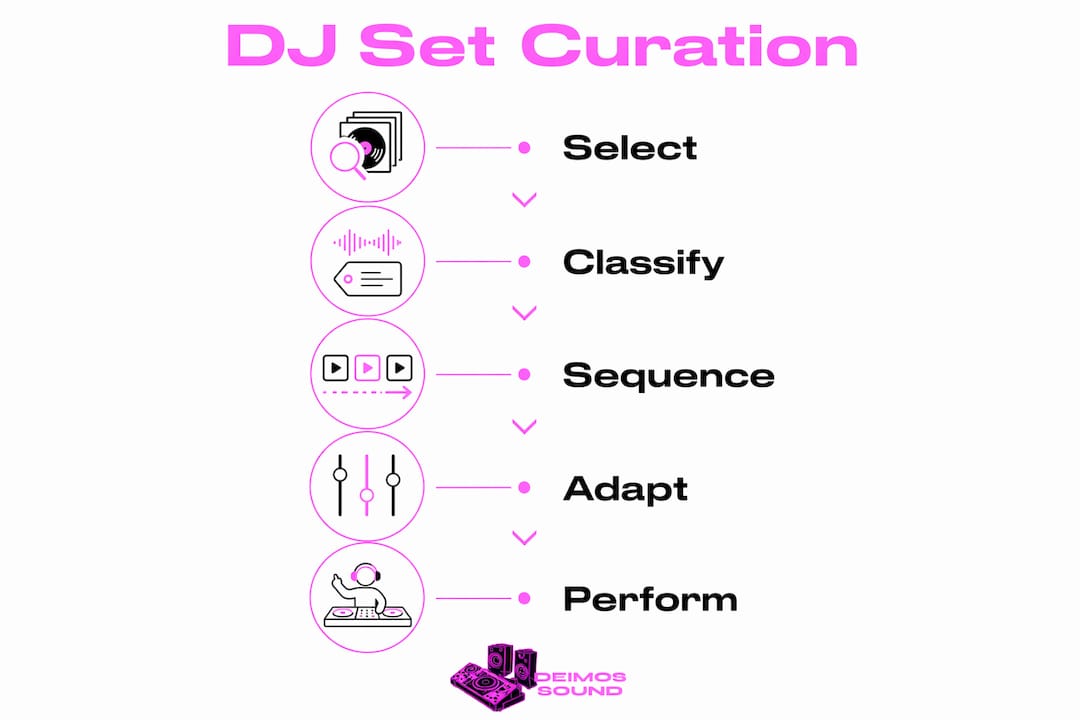
The process breaks into four distinct stages.
- Selection: Filter tracks by audio quality, relevance to the event context, and audience familiarity. Weak files, poorly mastered recordings, or tracks that clash with the room's vibe get cut before the set even begins.
- Classification: Label every track by energy level, mood, and function. A track might be tagged as a warm-up groove, a peak-hour weapon, or a reset tool. This labeling makes fast decisions possible under pressure.
- Sequencing: Arrange tracks to build emotional and energy arcs. The order matters as much as the selection. A peak-hour track dropped too early kills momentum. The same track placed correctly creates a defining moment.
- Technical execution: Apply harmonic mixing, BPM control, phrase alignment, and cue points to make transitions feel inevitable rather than mechanical.
Human DJ curation adds cultural and editorial perspective to music selection, creating narratives that guide crowd mood beyond algorithmic playlisting. That editorial point of view is what separates a skilled DJ from a shuffle function. Algorithms reflect patterns. DJs create stories.
Pro Tip: Build a "function tag" system for your library. Tag every track as Opener, Builder, Peak, Reset, or Closer. When you are live and the room shifts, you will find the right track in seconds instead of minutes.
How to structure and plan your DJ set for flow and crowd engagement
Structuring a DJ set for live performance follows a clear architecture. The goal is an energy arc: a shape that rises, peaks, breathes, and lands. Executing that arc requires planning before you touch the decks.
-
Plan your peak first. Planning your set peak with 3–5 strong tracks and building the narrative arc around it creates natural flow and memorable impact. Identify your two or three most powerful tracks. Everything else exists to set them up or bring the crowd down gracefully afterward.
-
Build in 3–4 track blocks. Group tracks into mini-sets of three to five tracks with strong chemistry. Each block has its own internal arc: a setup track, a payoff track, and a transition out. This structure gives you flexibility without losing coherence.
-
Follow the energy arc with BPM and mood shifts. Start with groove-oriented tracks at moderate tempo. Increase BPM gradually across blocks. Harmonic mixing involves following the Camelot wheel and limiting tempo changes to ±5–6 BPM to create seamless transitions that maintain flow. Abrupt key clashes or tempo jumps break the spell.
-
Schedule resets deliberately. Effective DJ sets employ tension and release cycles. Energy must fluctuate with peaks and well-timed resets to avoid audience exhaustion. A reset is not a failure. It is a breath that makes the next peak hit harder.
-
Prepare extra music. Preparing 20–30% more music than the set requires ensures adaptability to crowd energy fluctuations or unexpected vibe changes. Excess prepared tracks prevent scrambling and maintain flow when the room's energy shifts.
The 60/40 ratio is a practical framework worth adopting. Build 60% of your set from signature tracks your audience expects from you, and reserve 40% for experimental or context-specific selections. This balance protects your identity while leaving room to respond to the room.
Pro Tip: Never plan your set as a single linear list. Map it as a network of anchor tracks with multiple possible routes between them. If one path closes, another opens.
Understanding why live DJ performance outperforms algorithmic playlisting comes down to exactly this kind of real-time structural decision-making. No algorithm builds tension and release with crowd awareness.
How to maintain and refine your music library for effective curation
A well-curated set starts with a well-maintained library. Successful DJs maintain their music libraries through ongoing trimming, tagging, and folder auditing to ensure performance readiness under pressure. Regular library maintenance makes the right track choices obviously available, reducing search stress during live sets.
Practical library habits that make a measurable difference:
- Trim consistently. Remove low-quality audio files, duplicate tracks, and anything you have not played in over a year. A smaller, sharper library beats a bloated one every time.
- Update metadata religiously. BPM, key, genre, and energy rating should be accurate for every track. Inaccurate metadata breaks your tagging system and costs you time mid-set.
- Use layered tagging. Layered, metadata-driven categorization enables a single track to reside in multiple playlists or crates defined by function, mood, or energy. A track can live in both your "Late Night Techno" crate and your "Peak Hour" crate simultaneously.
- Build smart crates. Most professional DJ software supports dynamic playlists that auto-populate based on tags and ratings. Use them. They turn your library into a performance tool rather than a storage folder.
- Maintain a deep crate. A music library roughly 3 times larger than your set length gives you options for every crowd scenario. A two-hour set needs at least six hours of prepared, tagged, ready-to-play music behind it.
The goal of library management is not tidiness. The goal is speed and confidence under pressure. When the room shifts at 1:00 AM and you need a specific energy in thirty seconds, your library either delivers or it does not. Professional DJ equipment and software features like smart crates and waveform analysis make this process faster, but the underlying discipline is human.
How to adapt and improvise your curated set during live performances
Preparation is the foundation. Adaptability is the ceiling. The best-curated sets in the world fail when a DJ cannot read the room and respond.
Professional DJs use anchor tracks and mini-sets as flexible routes rather than rigid linear sets, allowing dynamic crowd-based decision-making. Flexible sequences of 3–5 tracks with high chemistry enable agility and spontaneous adjustments while maintaining structure. Think of your curated set as a map with multiple valid routes to the same destination, not a single road.
Crowd reading is a skill built through repetition. Watch body language, not just the dance floor density. A crowd that is dancing but not responding to drops needs a different tool than a crowd that is engaged but losing energy. These are different problems with different solutions, and your library needs answers to both.
Set curation is an ongoing practice beyond pre-gig preparation, involving continuous library refinement to perform confidently without searching. That insight reframes the entire discipline. Curation does not end when you press play. It continues through every transition, every read of the room, every decision to hold a track or cut it early.
A common mistake among newer DJs is over-preparation in the wrong direction. They plan every track in order and then freeze when the crowd does not follow the script. Amateurs often try to plan every track in order, but pros focus on flexible anchor tracks and well-constructed mini-sets for dynamic performance. Rigidity is the enemy of connection.
Pro Tip: Before every gig, identify three "emergency tracks" that work for almost any crowd and any energy level. These are your safety net. Knowing they exist removes panic from the equation.
Spotting talented DJs at live events often comes down to watching how they handle a crowd shift. The ones who adapt without visible stress are the ones with deep, well-organized libraries and flexible set frameworks.
Key Takeaways
Effective DJ set curation requires selection, classification, sequencing, and real-time adaptability working together as a continuous practice, not a one-time pre-gig task.
| Point | Details |
|---|---|
| Curation vs. playlisting | Curation applies editorial judgment and energy flow control; a playlist only reflects taste. |
| Energy arc structure | Plan your peak first, then build warm-up and landing sequences around it. |
| The 3x library rule | Maintain a music library at least three times larger than your set length for full crowd coverage. |
| Layered tagging | Tag every track by function, mood, and energy so the right choice surfaces in seconds live. |
| Flexibility over rigidity | Use anchor tracks and mini-set blocks as flexible routes, not a fixed linear order. |
Why curation is the skill that separates good DJs from great ones
I have watched DJs with technically perfect mixing lose a room because their track selection told no story. I have also watched DJs with rough transitions hold a crowd completely captivated because every track felt like the only possible next choice. That gap is curation.
The uncomfortable truth about DJ set curation is that most people treat it as a pre-gig task. They build a playlist, feel prepared, and show up. But the DJs who consistently deliver memorable performances treat curation as a daily practice. They are always trimming their library, always tagging new music, always thinking about function and placement. By the time they walk into a venue, the preparation is invisible because it is already done.
Strong curation also removes performance panic. When your library is organized and your set has flexible anchor points, you stop fearing the unexpected. A crowd that shifts energy becomes an opportunity rather than a crisis. That confidence shows in the performance, and crowds feel it.
My honest recommendation: spend as much time on your library as you do on your mixing technique. Mixing is the vehicle. Curation is the destination. One without the other gets you nowhere worth going.
— Otterpop
Deimos Sound brings expert curation to your next event
Great DJ set curation requires years of practice, a deep music library, and the ability to read a room in real time. Not every event organizer or party host has the time to develop those skills, and they should not have to.
Deimos Sound specializes in professionally curated DJ events that combine expert music selection with high-energy audio-visual production. Every event gets a tailored approach: the right tracks, the right energy arc, and the right atmosphere for your specific crowd. Whether you are planning a corporate function, a private party, or a large-scale event, Deimos Sound delivers a curated experience starting at $75 per hour. The music will not just play. It will perform.
FAQ
What is DJ set curation in simple terms?
DJ set curation is the process of selecting, organizing, and sequencing tracks to create a purposeful energy arc during a live performance. It differs from playlisting by applying editorial judgment and crowd responsiveness to every track choice.
What does DJ playlist curation mean for live events?
For live events, playlist curation means building a set with defined energy phases, including warm-up, peak, and landing, so the crowd experiences a complete emotional arc rather than a random sequence of songs.
How many tracks should a DJ prepare for a set?
A DJ should prepare a music library roughly three times larger than the set length. For a two-hour set, that means at least six hours of tagged, ready-to-play music to cover all possible crowd scenarios.
What is harmonic mixing and why does it matter?
Harmonic mixing uses the Camelot wheel to match tracks by musical key, limiting tempo shifts to ±5–6 BPM between tracks. It creates transitions that feel smooth and intentional rather than jarring or disconnected.
How do professional DJs adapt their sets during a live show?
Professional DJs use anchor tracks and flexible mini-set blocks instead of rigid linear playlists. This structure lets them shift direction based on crowd energy without losing the set's overall coherence or momentum.