
A live DJ performance is defined by real-time music selection, crowd reading, and technical manipulation that no streaming service can replicate. When you are planning a party or private event, the difference between a live DJ and a Spotify playlist is not just aesthetic. It is the difference between a passive audio backdrop and a fully responsive musical experience. Understanding why live DJ beats streaming services means understanding three things: technical limitations, artistic intentionality, and the irreplaceable human element that keeps a dance floor alive.
Why live DJ beats streaming services: the technical truth
Streaming platforms like Spotify are built for personal listening, not professional event performance. Spotify does not permit its library to be used in professional DJ software for public performances. That restriction alone disqualifies it from most live event contexts.
The reason goes deeper than licensing. Streaming audio is DRM-protected and compressed, which prevents real-time manipulation. Beatmatching, scratching, and pitch shifting all require direct access to unencrypted audio files. Streaming formats block that access entirely.
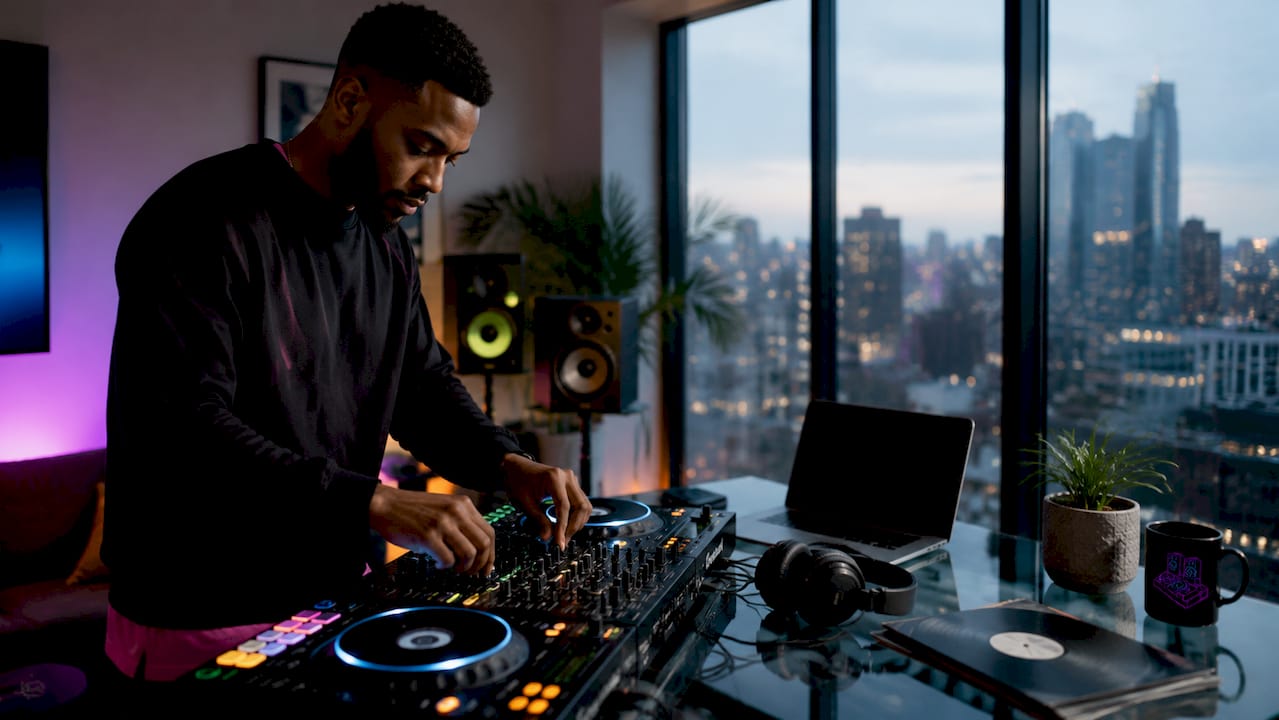
There is also the reliability problem. Venue WiFi is notoriously inconsistent, and streaming's internet dependency creates real failure risk mid-set. Professional DJs maintain offline, high-quality audio libraries precisely because they cannot afford a dropout at the peak of the night.
Some integrations do exist. Algoriddim's djay Pro connects with Apple Music to offer streaming catalogs inside DJ software. But these services still require active internet at the venue and carry offline limitations that constrain spontaneity. They are a workaround, not a solution.
- Streaming audio is encrypted and cannot be beatmatched or scratched in real time
- DRM restrictions prevent professional DJ software from accessing streaming libraries for public use
- Internet outages at venues can kill a streaming-based set with no recovery option
- Streaming catalogs change without notice as contracts expire, making track availability unreliable
- Offline DJ libraries give performers complete control over their set regardless of connectivity
Pro Tip: If you are evaluating a DJ for your event, ask whether they use an offline library. A professional who owns their music will never lose a track to a licensing change or a WiFi outage.
How does a live DJ create an experience streaming cannot?
The core advantage of a live DJ over a streaming playlist is intentionality. Algorithms optimize individual playback but cannot mimic collective social energy or live responses. A DJ reads the room, not a user profile.
That distinction matters enormously at events. When the energy on the dance floor dips, a skilled DJ senses it and responds within seconds. A playlist keeps playing the next queued track regardless of what is happening in the room.
"A live DJ's ability to instantly shift genres, manage energy curves, and create anticipation moments is irreplaceable in delivering a cohesive party atmosphere — skills streaming algorithms cannot replicate." — partymusicplaylist.com
Here is how that plays out in practice at a real event:
- Reading the crowd at arrival. A DJ watches how guests enter, their age range, and their energy level, then adjusts the opening set accordingly. A playlist starts at track one regardless.
- Responding to announcements. When a host grabs the mic for a toast or a surprise, a DJ fades the music gracefully. A streaming playlist does not know the toast is happening.
- Handling requests in real time. A DJ can weave a guest request into the set without breaking flow. A digital playlist requires someone to manually interrupt the queue.
- Building emotional arcs. A skilled DJ constructs a musical narrative over hours, moving from warm-up energy to peak intensity and back down. That arc is intentional, not algorithmic.
- Recovering from the unexpected. If a fight breaks out or the vibe shifts suddenly, a DJ can pivot the music to defuse or redirect the room's energy. No streaming service has that capability.
Live DJs use human intuition to build emotional arcs that algorithms cannot predict. That is the backbone of every memorable event.
Live DJ set vs. streaming playlist: which wins?
The comparison between a live DJ set and a streaming playlist is not close when the goal is a high-energy, memorable event. DJ sets include beatmatching, scratching, pitch shifting, and live effects that curated playlists simply do not provide. These elements create a continuous, immersive music flow that keeps guests engaged rather than passively listening.
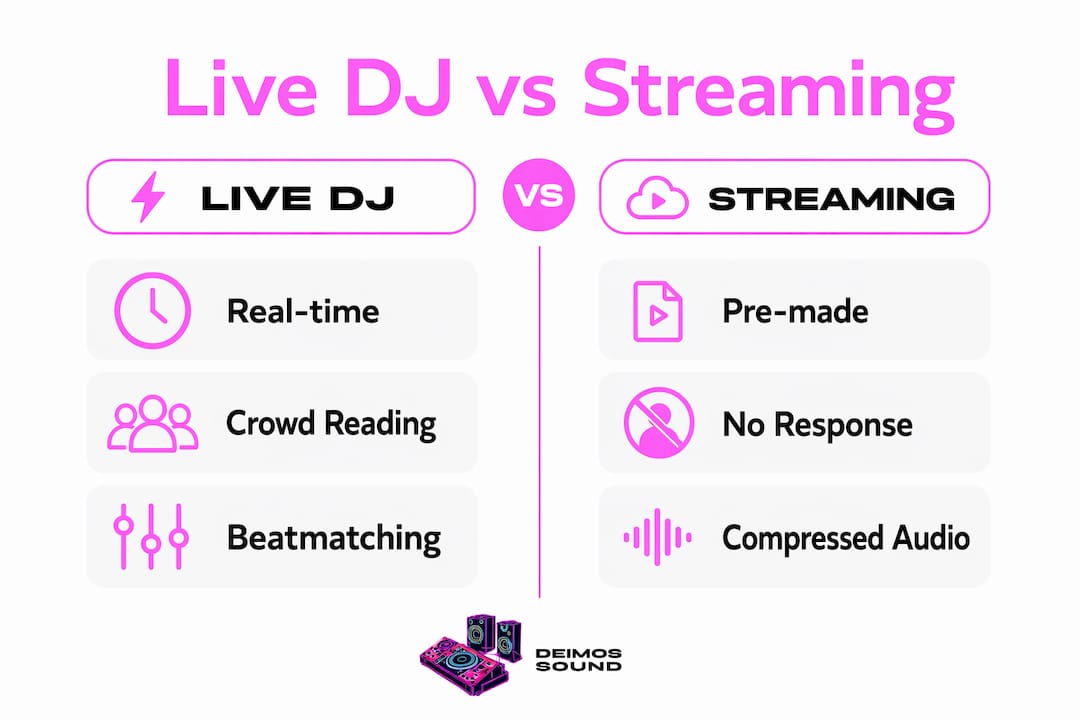
Streaming playlists are pre-made selections with no interaction or adaptation to event energy changes. They are passive by design. That works for background music at a dinner party. It does not work for a wedding reception, a corporate gala, or a birthday celebration where the energy needs to build and shift.
| Feature | Live DJ set | Streaming playlist |
|---|---|---|
| Real-time crowd response | Yes | No |
| Beatmatching and transitions | Yes | No |
| Offline reliability | Yes | No |
| Track availability consistency | Yes | Varies by contract |
| Legal compliance for public events | Clear | Complex |
| Customization to event theme | Full | Limited |
| Response to announcements | Immediate | None |
| Lighting and production integration | Yes | Rarely |
The table makes the case plainly. A streaming playlist offers convenience and a large catalog. A live DJ set offers everything else. For event hosts who want guests talking about the night for years, the choice is clear.
What are the practical benefits of hiring a live DJ?
Hiring a live DJ for your event solves problems that streaming services create. The practical benefits go beyond music quality and touch on legal compliance, reliability, and the overall production value of your gathering.
On the legal side, venues' public performance licenses do not cover digital transmission or recording of DJ sets. Livestreaming a DJ set using a streaming service catalog often results in content being muted or blocked due to multiple rights holders. A professional DJ performing with a properly licensed music library sidesteps these issues entirely. Legal experts confirm that live DJ performances are safer and more compliant for public events than streaming-based alternatives.
The production integration benefit is one that event hosts often overlook. A professional DJ can sync their set with lighting cues, coordinate with your event timeline, and adjust the music pacing to match speeches, dinner service, or a first dance. Streaming services have no mechanism for that kind of coordination. You can read more about syncing sound and lighting to understand how much that integration adds to the guest experience.
Key practical advantages of a live DJ include:
- No mid-event technical failures from WiFi drops or streaming outages
- Full control over music pacing to match the event timeline
- Ability to take and honor guest requests without disrupting the set
- Clear legal standing for public performance without copyright complications
- Professional sound quality from owned, high-resolution audio files
- Coordination with lighting, visuals, and event production elements
Pro Tip: Ask your DJ for a pre-event consultation. A good DJ will want to know your event timeline, guest demographics, and key moments like toasts or first dances so the music supports every beat of the night.
Understanding why DJ sound differs from recorded music playback also helps event hosts appreciate what they are actually paying for. It is not just someone pressing play. It is a live performance built around your guests.
Key Takeaways
Live DJ performances beat streaming services because they deliver real-time adaptability, legal compliance, and technical depth that no playlist or algorithm can match.
| Point | Details |
|---|---|
| Streaming has hard technical limits | DRM encryption blocks beatmatching, scratching, and real-time mixing in professional DJ software. |
| Reliability favors offline DJ libraries | Venue WiFi outages can kill a streaming set; professional DJs own their music and perform offline. |
| Human intuition drives crowd energy | DJs read collective mood and build emotional arcs that algorithms cannot predict or replicate. |
| Legal compliance is clearer with live DJs | Venue performance licenses do not cover streaming transmissions, making live DJ sets the safer legal choice. |
| Production integration sets DJs apart | A live DJ coordinates with lighting, event timelines, and announcements in ways no playlist can. |
Why I still believe no algorithm replaces a great DJ
After watching hundreds of events, the pattern is consistent. The nights guests remember are the ones where the music felt alive. Not curated. Alive.
I have seen a DJ save a reception that was losing energy at 9 p.m. by dropping a single unexpected track that pulled everyone back to the floor. No algorithm would have made that call. It required reading twenty faces at once and trusting a gut instinct built over years of performance.
The technology conversation around streaming and DJ software is genuinely interesting. Algoriddim's djay Pro and similar tools show that the industry is experimenting with hybrid approaches. But every integration still hits the same wall: internet dependency, licensing restrictions, and the absence of human judgment. Those are not small gaps. They are fundamental.
My honest advice to any event host: do not treat music as a line item to cut. The right professional DJ is the difference between a party people attend and a party people talk about. Streaming is a tool. A DJ is a performer. Those are not the same thing.
— Otterpop
Deimos Sound brings live DJ expertise to your event
Deimos Sound provides professional DJ sound and lighting services for parties, corporate events, and private gatherings, with rates starting at just $75 per hour. Every set is built around your event's specific energy, timeline, and guest profile.
Where streaming services leave gaps in reliability, legal compliance, and crowd responsiveness, Deimos Sound fills them with experienced performers and professional-grade equipment. The result is an atmosphere your guests feel from the first track to the last. Visit Deimos Sound to check availability and book a DJ for your next event.
FAQ
Why can't a DJ just use Spotify at an event?
Spotify's licensing terms prohibit its library from being used in professional DJ software for public performances. The audio is also DRM-encrypted, which blocks beatmatching and real-time mixing.
Are streaming playlists ever good enough for events?
Streaming playlists work for low-key background music at small gatherings. For any event where crowd energy, timing, and guest interaction matter, a live DJ is the better choice.
Is hiring a live DJ legal for public events?
Yes. A professional DJ performing with a properly licensed music library is the legally cleaner option. Venue performance licenses do not cover digital streaming transmissions, which creates copyright risk with streaming-based setups.
What does a live DJ do that a playlist cannot?
A live DJ beatmatches tracks, reads the crowd, responds to announcements, takes requests, and builds an emotional arc across the night. A playlist does none of those things.
How much does a professional DJ cost for an event?
Pricing varies by market and experience level. Deimos Sound offers professional DJ services starting at $75 per hour, making live DJ performance accessible for a wide range of event budgets.