
Reverb is defined as the persistence of sound after its source stops, created by thousands of reflected sound waves decaying in a physical space. The role of reverb in DJ sound goes far beyond adding a shimmering texture to a synth pad. It is a spatial positioning tool that controls perceived distance, emotional scale, and acoustic depth within a mix. Professionals who understand this distinction use techniques like pre-delay, decay shaping, and reverb tail EQ to build three-dimensional audio environments. Those who treat reverb as decoration tend to produce muddy, undefined mixes that lose energy on large systems.
How reverb parameters shape the DJ mix environment
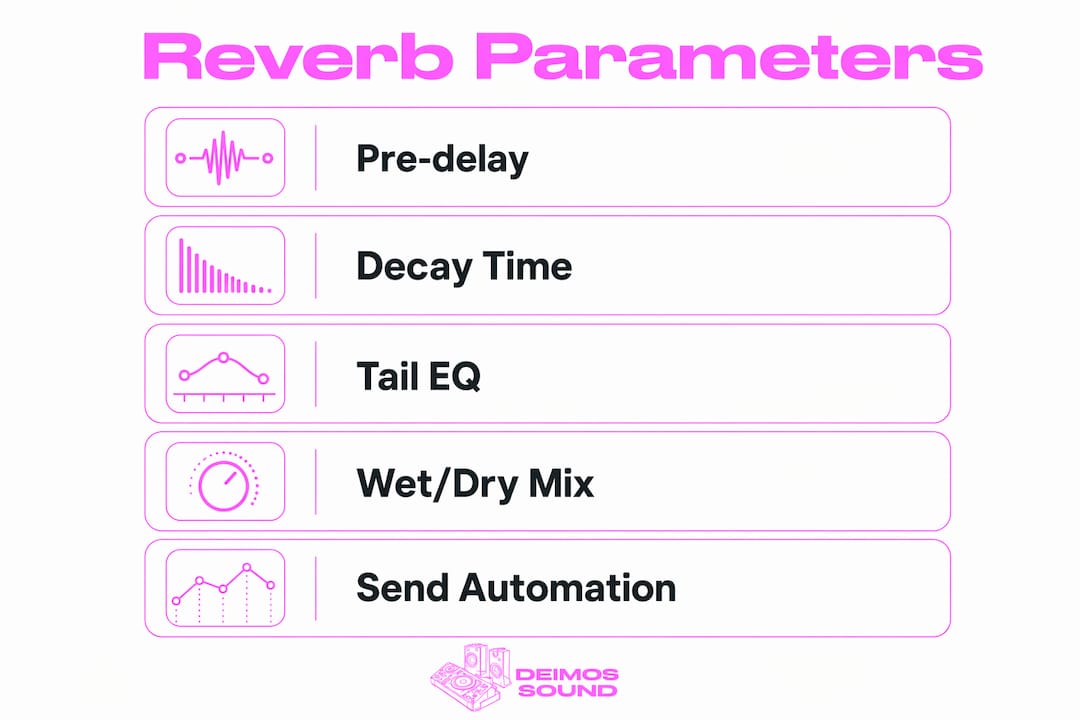
Reverb's power lives in its parameters, not its presets. Three variables separate a professional, immersive mix from a low-definition wash: pre-delay, decay time, and tail EQ. Mastering these three variables produces clear spatial positioning and emotional impact, regardless of which reverb algorithm you choose.
Pre-delay and transient clarity
Pre-delay is the gap between the dry signal and the first reflected sound. A 20–40ms pre-delay keeps attack transients sharp and defined while still adding spatial depth. Without it, the reverb tail smears the attack, and the mix loses punch. In a club environment, where sub-bass lines and kick drums need to hit with physical force, smeared transients translate directly to a flat, lifeless dancefloor response.
Decay time and perceived space
Decay time controls how long the reverb tail rings before it disappears. Short decay times, roughly under one second, create an intimate room feel. Long decay times, stretching past three seconds, signal grandeur and scale. Reverb encodes emotional weight this way: a dry vocal feels close and personal, while a cathedral-length reverb tail signals proclamation and distance. DJs who automate decay time across a set can shift the crowd's emotional experience without changing a single track.
Tail EQ and low-end protection
The reverb tail is where most mixes fall apart. Low frequencies accumulate in reverb returns and compete directly with kick drums and bass lines. High-pass filtering below 200–300Hz on every reverb return removes that buildup and preserves low-end definition. This single step is the most commonly skipped and the most damaging when ignored.
Key parameters to dial in for every reverb instance:
- Pre-delay: Set between 20–40ms to protect transient attack
- Decay time: Match to the energy of the section, short for dense drops, long for breakdowns
- High-pass filter: Cut below 200–300Hz on the reverb return
- Wet/dry ratio: Keep the wet signal subtle enough that its absence is more noticeable than its presence
- Stereo width: Wider reverb tails push sounds back in the mix and add dimension
Pro Tip: Automate your wet/dry ratio across the set. Open the reverb wide during breakdowns and pull it back during dense drops to keep the low end tight and the mix readable.
What are the best techniques for live DJ reverb setups?
Applying reverb in a live DJ context requires a different mindset than studio production. The goal is spatial cohesion without sacrificing punch, and the approach that achieves this most reliably is the shared reverb send.
-
Route multiple channels to one shared reverb bus. A single shared reverb return at a low level unifies disparate tracks into one acoustic space. This "glue reverb" approach creates cohesion that feels natural rather than obvious. It also reduces processing load on hardware, which matters in live performance.
-
Apply reverb selectively by frequency band. Modern DJ hardware like the RMX-IGNITE features independent Isolate FX controls that let you add reverb to mids and highs while keeping the low end completely dry. This preserves the kick and bass punch that drives dancefloor energy.
-
Control wet/dry mix for spatial positioning. A low wet signal, around 15–25%, places a sound in the background. A higher wet signal, above 40%, pushes it into an ambient wash. Use this range deliberately to position elements in three-dimensional space rather than applying a fixed setting to every channel.
-
Automate send levels dynamically. Send level automation shapes perceived depth and clarity across a set. Open reverb sends during emotional peaks and breakdowns. Pull them back during dense, high-energy sections to keep the mix clean and the transients sharp.
-
High-pass filter every reverb return. This applies in the studio and in live rigs equally. No exceptions. The low-frequency buildup that accumulates in unfiltered reverb returns competes with kick and bass, the two elements that define a DJ mix's physical impact.
Pro Tip: Treat your reverb send like a lighting dimmer, not an on/off switch. Gradual, subtle movements across a set create a sense of space that breathes with the music rather than sitting static in the background.
Understanding how DJ sound differs from recorded music helps clarify why live reverb management demands this level of attention. Room acoustics, speaker placement, and crowd absorption all interact with the reverb you add at the mixer.
Common mistakes DJs make with reverb
The most damaging reverb mistake is the belief that more reverb creates more impact. The opposite is true. Reverb is ideally audible only when removed. When it becomes the dominant texture in a mix, it signals a loss of control, not creative ambition.
Common reverb errors that undermine mix quality:
- Skipping the high-pass filter on reverb returns. Low-frequency reverb energy clouds the kick and bass, reducing the physical impact that dancefloor music depends on.
- Using reverb as an insert rather than a send. Insert reverb processes one channel in isolation. Send routing allows multiple channels to share one acoustic space, which sounds more natural and uses less processing power.
- Setting decay times too long for the tempo. A four-second reverb tail on a 140 BPM track creates a wash of overlapping reflections that destroys rhythmic clarity. Match decay time to the tempo and energy of the music.
- Ignoring send level automation. A static reverb level across an entire set flattens the emotional arc. Dynamic send automation is what separates a technically competent mix from an emotionally engaging one.
- Applying identical reverb settings to every element. Kick drums, vocals, and synth pads occupy different spatial positions in a mix. Each needs its own reverb treatment, or the mix collapses into a single undifferentiated plane.
The "economy of space" principle in sound engineering captures this well. Every reverb tail occupies sonic space, and that space is finite. Manage it deliberately, or the mix manages itself into mud.
How does reverb work alongside delay in DJ mixing?
Reverb and delay both create spatial perception, but they do it differently. Delay produces discrete, rhythmic repetitions of a signal. Reverb produces a dense, continuous decay of reflections. Used together, they create layered spatial environments that feel genuinely three-dimensional.
Delay works best for rhythmic reinforcement and presence. A quarter-note delay on a vocal or synth hook adds energy and forward motion. It keeps the element in the foreground while extending its presence. Reverb, by contrast, pushes elements back into the mix and adds scale. The combination of a short delay with a long reverb tail creates the illusion of a large, live acoustic space.
Sidechain compression applied to the reverb return is one of the most effective tools for maintaining clarity when combining both effects. Trigger the sidechain from the kick drum, and the reverb ducks briefly on every beat. The result is a mix that feels spacious during the gaps between transients but stays punchy and defined on the hits. This technique appears consistently in professional electronic music production and translates directly to live DJ setups.
Pro Tip: Set your delay time to sync with the track's BPM using a tap tempo function. A rhythmically synced delay reinforces the groove rather than fighting it, and it leaves cleaner space for the reverb tail to breathe.
Crowd engagement in nightclub settings depends heavily on this spatial layering. Producers and DJs who shape sound for nightclub crowds consistently cite spatial depth as a primary factor in sustaining energy across a long set.
Key Takeaways
Reverb's role in DJ sound is spatial positioning, not decoration. Controlling pre-delay, tail EQ, and send automation separates immersive mixes from muddy ones.
| Point | Details |
|---|---|
| Pre-delay protects transients | Set 20–40ms to keep attack sharp and prevent reverb from smearing the dry signal. |
| High-pass filter every return | Cut below 200–300Hz on reverb returns to protect kick and bass definition. |
| Shared reverb bus creates cohesion | Route multiple channels to one reverb send for a natural, unified acoustic space. |
| Automate send levels dynamically | Open reverb during breakdowns and pull back during dense sections to shape emotional arc. |
| Combine reverb with delay deliberately | Use delay for rhythmic presence and reverb for scale; sidechain the reverb to the kick for clarity. |
Reverb as a spatial language, not a sound effect
My honest view is that most DJs learn reverb backwards. They start with presets, find one they like, and apply it broadly. The result sounds fine in isolation and falls apart on a large system. The shift that changes everything is treating reverb as a spatial language rather than a sound effect.
When I think about what reverb actually does, it encodes distance and emotional scale into audio. A dry signal sits right in front of the listener. A signal with 30ms of pre-delay and a two-second decay sits ten meters back in a large room. That positioning is a creative decision, not a technical afterthought. The best DJs I have heard use reverb the way a film director uses camera distance: deliberately, with intention, and always in service of the emotional moment.
The practical implication is that you should practice parameter adjustment in isolation before applying it live. Spend time with just pre-delay, moving it from 0ms to 60ms on a single element, and listen to what happens to the attack. Then do the same with decay time. That kind of focused listening builds the muscle memory you need to make fast, confident adjustments during a live set. Subtlety and dynamic control are the marks of professional reverb use. The crowd will not notice the reverb. They will notice how the room feels.
— Otterpop
Deimos Sound brings professional spatial audio to your event
Professional reverb management is one part of a larger system of decisions that define how an event sounds and feels. Getting that system right requires more than good equipment.
Deimos Sound brings expert DJ sound and lighting services to events of every scale, with a tailored approach that accounts for room acoustics, crowd size, and the specific energy each event demands. The team applies the same spatial audio principles covered here, including careful reverb management, frequency-band control, and dynamic effect automation, to deliver clear, immersive sound that holds up across the full arc of a performance. Rates start at $75 per hour. Reach out through Deimos Sound's event services to discuss what your next event needs.
FAQ
What is the primary role of reverb in DJ sound?
Reverb's primary role is spatial positioning. It controls the perceived distance and emotional scale of sounds within a mix by simulating acoustic reflections.
What pre-delay setting works best for live DJ performance?
A pre-delay of 20–40ms preserves attack transients while adding spatial depth. Without pre-delay, the reverb tail smears the dry signal and reduces mix clarity.
Why does reverb make a DJ mix sound muddy?
Reverb causes muddiness when low-frequency energy builds up in the reverb return. High-pass filtering below 200–300Hz on every reverb return eliminates this problem.
Should DJs use reverb as an insert or a send effect?
Send routing is the professional standard. A shared reverb send unifies multiple channels into one acoustic space and produces more natural-sounding cohesion than insert reverb.
How does reverb differ from delay in a DJ mix?
Delay creates discrete, rhythmic repetitions that reinforce groove and presence. Reverb creates a continuous decay of reflections that adds scale and pushes elements back in the mix.