
Event sound systems are defined as configurations of audio equipment engineered to deliver clear, consistent sound across a specific venue and audience size. Understanding event sound system types explained in practical terms means knowing which speaker format, amplification method, and signal processing approach fits your event's scale and goals. The core categories include active speakers, passive speakers, column arrays, line arrays, and subwoofer systems, each optimized for different acoustic environments. Choosing the wrong category does not just affect volume. It affects speech intelligibility, audience engagement, and the overall success of your event.
What are the main types of event sound systems?
The five primary audio equipment categories for events each serve a distinct purpose, and matching the right one to your event is the single most important audio decision you will make.
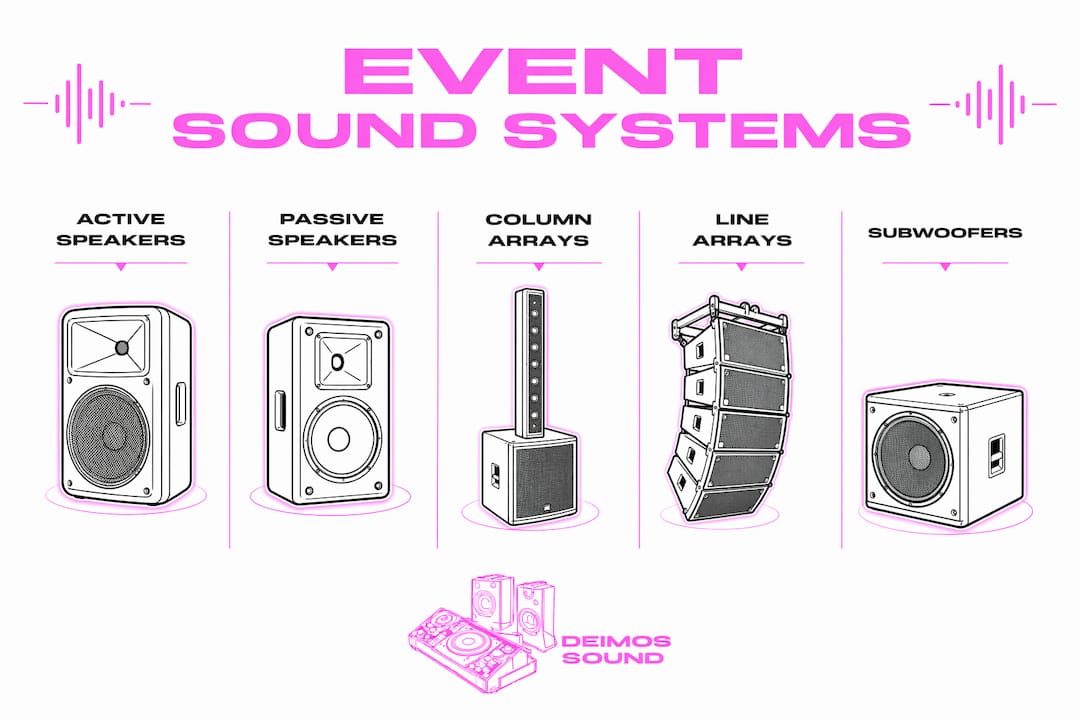
Active speakers contain built-in amplifiers, which means faster deployment and fewer cables. Active speakers are preferred for mobile setups and quick-turnaround events like corporate presentations, birthday parties, and pop-up markets. You plug them in, connect your source, and they are ready. That simplicity makes them the go-to choice for event coordinators who need reliable audio without a dedicated audio engineer on site.
Passive speakers require an external amplifier to drive them. Passive systems suit permanent installations and complex multi-speaker setups where a central amp rack feeds multiple cabinets across a large venue. A hotel ballroom with ceiling speakers and wall-mounted cabinets is a classic passive system. The trade-off is setup time and expertise, but the payoff is precise control over every speaker zone.
Column array speakers are tall, narrow cabinets that control vertical sound dispersion with precision. Column arrays are increasingly favored over traditional box speakers for speech intelligibility at conferences, houses of worship, and award ceremonies. Their narrow vertical pattern keeps sound off ceilings and floors, reducing echo and reverb. If your event is speech-heavy, a column array will outperform a standard cabinet at the same price point.
Line array systems hang or stack multiple speaker modules in a curved arc to project sound evenly across long distances. Line arrays provide consistent coverage at concerts, stadiums, and outdoor festivals where audiences stretch hundreds of feet from the stage. The physics behind them reduce volume drop-off over distance, so the back row hears nearly the same level as the front. These systems require professional rigging and are not practical for small or mid-size events.
Subwoofers handle the low-frequency range, typically below 80 Hz, that standard speakers cannot reproduce at adequate levels. Systems without subwoofers sound thin at higher volumes, especially in larger venues. For DJ events, live bands, and dance parties, subwoofers are the backbone of the sound system, delivering the physical impact that makes music feel alive rather than just audible.
| System type | Best for | Key advantage |
|---|---|---|
| Active speakers | Corporate events, parties, pop-ups | Fast setup, no external amp needed |
| Passive speakers | Permanent venues, multi-zone installs | Centralized amp control |
| Column arrays | Conferences, ceremonies, speeches | High speech intelligibility |
| Line arrays | Concerts, festivals, large outdoor events | Even long-distance coverage |
| Subwoofers | DJ events, live bands, dance floors | Full-range bass impact |
How do venue size and event goals shape your system choice?
The right audio equipment for events depends on three variables working together: the physical size of the space, the acoustic properties of the venue, and the primary purpose of the event.
Small events with under 100 attendees in a standard indoor room work well with a stereo pair of active speakers. A corporate breakfast, a small wedding reception, or a private birthday party falls into this category. Two well-placed active speakers at ear level, angled toward the audience, cover the room without overpowering it.
Medium-size events from 100 to 500 attendees introduce new challenges. Outdoor spaces require weather-resistant, durable systems because standard indoor speakers degrade quickly in humidity and direct sun. Indoor venues at this scale often have parallel walls that create flutter echo, which a column array or a properly aimed line array can reduce significantly. The event type matters just as much as the size. A 300-person conference needs speech clarity above all else. A 300-person dance event needs sub-bass and high SPL (sound pressure level).
Large events above 500 attendees almost always require line arrays, professional mixing consoles, and dedicated subwoofer stacks. Outdoor concerts and festivals add wind, ambient noise, and unpredictable acoustics to the equation. Scalable and modular systems let you add speaker cabinets and amplifier channels as the audience grows, without replacing the core system. That modularity is a practical advantage for event coordinators managing multi-stage or multi-room programs.
Portability versus permanent installation is a real trade-off. A portable active system gives you flexibility across multiple venues. A fixed passive system gives you optimized acoustics for one specific room. If you manage events at a single venue, a permanent installation pays off over time. If you move between locations, portability wins every time.
What setup considerations improve sound system performance?
Getting the most from any event audio solution comes down to placement, signal processing, and the control chain between your sources and your speakers.
Speaker placement is the single most impactful variable in any setup. Proper speaker placement and DSP achieve better clarity than simply increasing volume. Speakers aimed at the audience rather than at walls or ceilings deliver intelligible sound at lower SPL, which reduces listener fatigue and feedback risk. A speaker mounted too high and angled down will reflect off the floor and create comb filtering, a phase cancellation effect that muddies speech.
Digital signal processing (DSP) is the technology that shapes the audio signal before it reaches the speaker. DSP functions include equalization, compression, delay alignment, and noise reduction. Equalization cuts problem frequencies that cause feedback or boom in a specific room. Delay alignment synchronizes multiple speakers so sound arrives at the listener's ears at the same time, regardless of speaker position. Without DSP, even a high-quality speaker system sounds uneven in a complex acoustic environment.
Mixing consoles balance multiple inputs, including microphones, instruments, and playback devices, into a single coherent output. For events with a DJ, a live band, and a presenter microphone, a mixer is not optional. It is the control center that prevents one source from overwhelming another. Digital mixers add onboard DSP, scene recall, and remote control via tablet, which simplifies operation for a single-operator event.
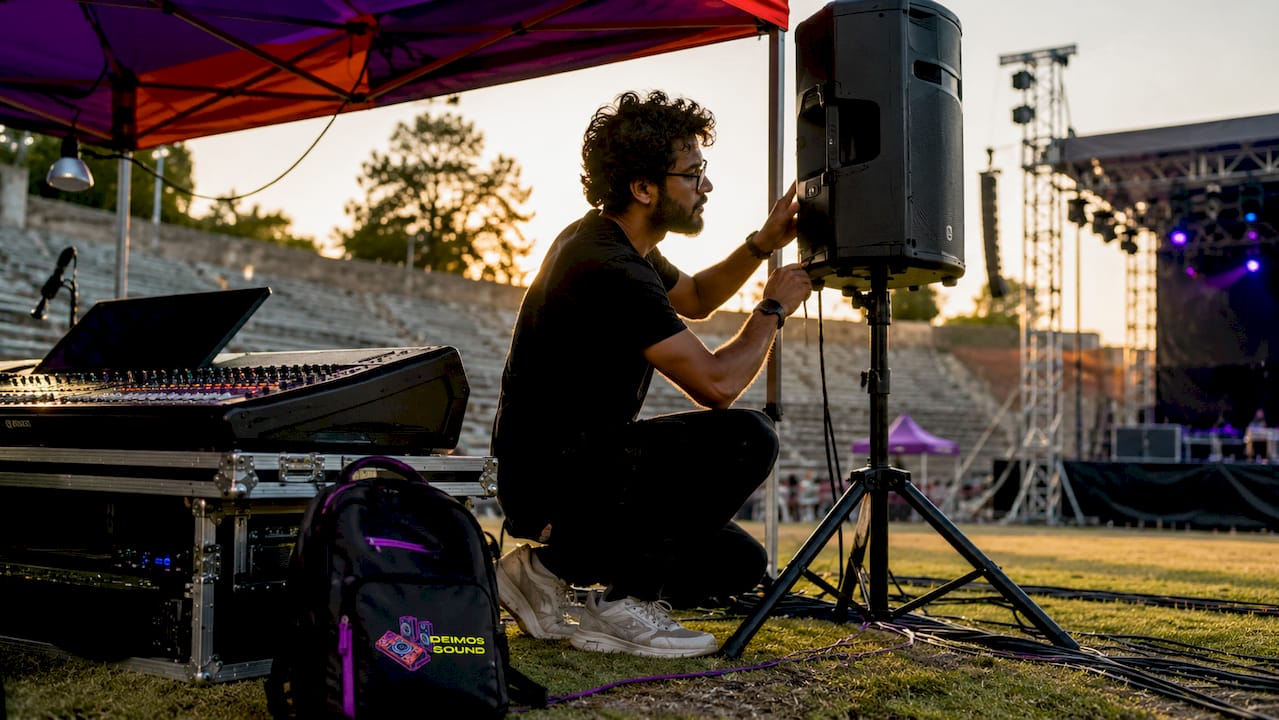
Wireless and battery-powered systems reduce cable clutter and allow flexible speaker placement in venues where running cable is impractical. Battery-powered speakers are particularly useful for outdoor ceremonies, rooftop events, and historic venues where drilling or cable management is restricted.
Pro Tip: Always run a full sound check at the actual event volume level, not at a low rehearsal level. Room acoustics change significantly when the space fills with people, who absorb high frequencies and alter the reverb time.
Hybrid events require a separate layer of planning. Hybrid events need distinct audio feeds for in-room, streaming, and interpretation channels. Feeding the room mix directly into a streaming encoder causes echo for remote participants because the room mix includes reverb and ambient noise. A clean, direct feed from the mixing console, before room processing, solves this problem. Treating audio as integrated infrastructure with separate processing, distribution, and output layers is the professional standard for any event with a streaming component.
What are the common pitfalls when choosing event sound systems?
The most frequent mistake event coordinators make is selecting a system based on volume rather than coverage. A single powerful speaker pointed at the front of the room leaves the back half of the audience straining to hear. Two moderately powered speakers placed at the sides of the room cover the same space more evenly and at lower volume.
Underpowered systems are a real risk, but oversized systems create their own problems. A line array designed for a 2,000-person outdoor festival will overpower a 200-person ballroom, creating uncontrollable reflections and feedback. Matching system scale to venue scale is a discipline, not a guess.
Pro Tip: When evaluating a sound system for your event, ask the provider for the system's coverage angle and SPL rating at your expected audience distance. Those two numbers tell you more than wattage alone.
Reliability is non-negotiable for outdoor events. Outdoor event professionals prioritize weather-resistant and durable systems because a failed speaker mid-event has no quick fix. Budget systems that look adequate on paper often lack the IP (ingress protection) rating needed to survive humidity, dust, or light rain. Spending more on a reliable system upfront costs far less than a failed event.
Planning for multi-room or streaming audio feeds requires a dedicated signal routing plan before the event day. Coordinators who treat audio as an afterthought discover the problem when it is too late to fix. A professional DJ equipment setup includes signal routing, backup sources, and redundant connections as standard practice. That same discipline applies to any event audio setup, regardless of format.
Key Takeaways
Choosing the right event sound system comes down to matching speaker type, venue scale, and event purpose, with DSP and proper placement delivering more clarity than raw volume alone.
| Point | Details |
|---|---|
| Match system to event type | Column arrays suit speech events; line arrays suit large concerts; active speakers suit mobile setups. |
| Placement beats volume | Proper speaker positioning and DSP deliver better clarity than simply increasing power output. |
| Reliability matters outdoors | Weather-resistant, battery-powered systems prevent costly failures at outdoor events. |
| Hybrid events need separate feeds | Streaming and in-room audio require distinct signal paths to avoid echo and poor remote quality. |
| Scalable systems protect your investment | Modular systems expand with your event without requiring full hardware replacement. |
Why I think most event coordinators underestimate audio infrastructure
The conversation about event sound almost always starts with "how loud does it need to be?" That is the wrong question. The right question is "how evenly does it need to cover the room?" I have seen expensive speaker systems fail to serve a 200-person conference because the integrator stacked all the power at the front of the room. The back third of the audience heard muffled speech. The client blamed the microphone.
What changed my thinking was watching a well-designed column array system handle a 400-person conference in a reverberant hotel ballroom. The system was not particularly powerful by spec. But the vertical dispersion control kept sound off the ceiling and the rear wall, and the room stayed quiet and intelligible from front to back. That is audio infrastructure thinking, not just speaker shopping.
The growing prevalence of hybrid events has made this even more critical. A live event that also streams to 500 remote participants is two separate audio productions running simultaneously. Coordinators who treat them as one production end up with a compromised result for both audiences. The integrated audio approach treats processing, distribution, and output as distinct layers, each requiring its own attention.
My honest recommendation is to invest in a provider who asks about your event goals before quoting equipment. The provider who leads with wattage is selling hardware. The provider who leads with coverage, intelligibility, and reliability is selling outcomes. Those are very different conversations, and only one of them ends with an event your attendees remember for the right reasons.
— Otterpop
How Deimos Sound delivers professional event audio
Planning an event means making dozens of decisions, and audio should not be the one that keeps you up the night before.
Deimos Sound provides tailored DJ sound and lighting packages for events of every scale, from intimate private parties to large corporate gatherings. Every setup includes professional-grade audio equipment selected for your specific venue and event type, with full technical support from load-in to final song. Rates start at $75 per hour, making professional event audio accessible without the guesswork of sourcing and configuring equipment yourself. When you want live DJ performance that outperforms a playlist every time, Deimos Sound delivers the sound and energy your event deserves.
FAQ
What is the difference between active and passive speakers?
Active speakers have built-in amplifiers and connect directly to an audio source, making them faster to set up. Passive speakers require a separate external amplifier and are better suited for permanent installations or complex multi-zone systems.
What type of sound system works best for a conference or speech event?
Column array speakers are the best choice for conferences and speech-focused events because their controlled vertical dispersion reduces echo and maintains vocal clarity across the room.
How do I choose a sound system for an outdoor event?
Outdoor events require weather-resistant, durable, and ideally battery-powered systems to handle humidity, dust, and temperature changes. Scalable systems that allow you to add speakers as the audience grows are the most practical choice.
Do I need a subwoofer for my event?
Subwoofers are necessary for DJ events, live bands, and any music-focused gathering where full-range bass is part of the experience. Speech-only events like conferences and seminars typically do not require subwoofers.
What is DSP and why does it matter for event audio?
DSP stands for digital signal processing, a technology that applies equalization, compression, and delay alignment to the audio signal before it reaches the speakers. Proper DSP use delivers better intelligibility and coverage than increasing volume alone.